 AXENOR
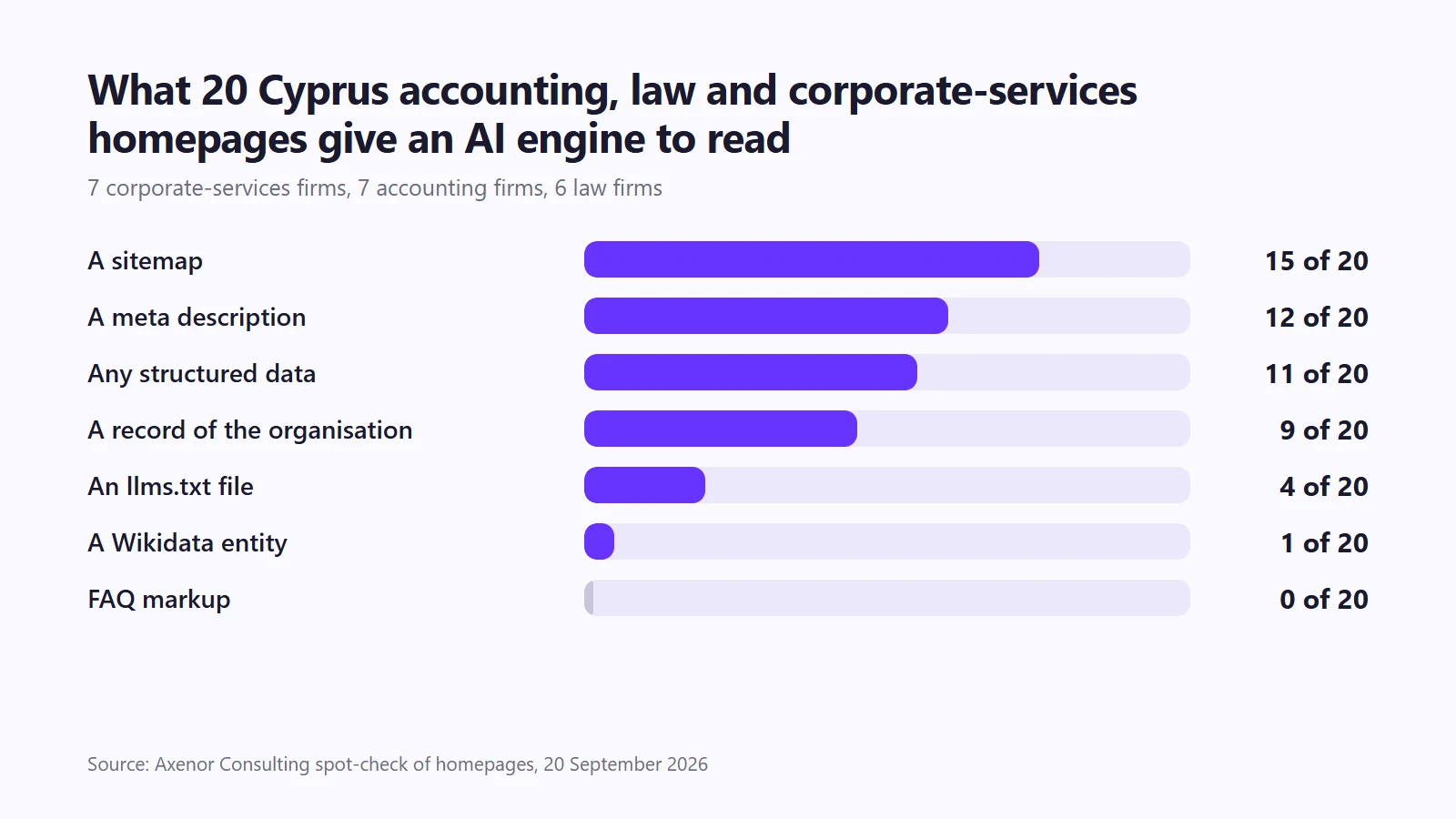
In September 2026 Axenor Consulting checked the homepages of 20 accounting, law and corporate-services firms in Cyprus for what an AI engine can read. Nine carry no structured data at all, and 11 give an engine no record of the organisation. Eight have no meta description. None carries FAQ markup. One firm has a Wikidata entity, and none has a Wikipedia article. No firm blocks the AI search crawlers: the door is open, with little behind it to read.
Search for the best corporate-services providers in Cyprus and the results lean on a third-party top-ten list and the Big Four. The boutique firms are missing. Our June check of 10 firms suggested why: seven had no structured data an engine could use. This is the same check at twice the size, across three professions, with the method written down so that anyone can rerun it.
How did we check the firms' websites?
We fetched the homepage of each firm once, on 20 September 2026, with a plain HTTP request and no JavaScript, which is how AI crawlers read a page. For each site we recorded:
- the structured data (JSON-LD) on the homepage, and which schema.org types it declares
- the title and meta description
- any FAQ markup, and any mention of or link to an FAQ
- the robots.txt rules for eight crawlers, including OAI-SearchBot, PerplexityBot, ClaudeBot and Bingbot
- whether the site serves an llms.txt file and a sitemap
- language alternates, and the amount of text in the raw HTML
- whether the firm has a Wikidata entity or a Wikipedia article
The sample is 7 corporate-services firms drawn from the Cyprus Fiduciary Association's member list, 7 accounting and audit firms, and 6 law firms. The candidate list and its order were fixed before any result was seen, and the first firms whose sites loaded were kept. We publish counts, not names. The limits are plain: 20 firms, one date, homepages only. A firm may carry markup deeper in its site that this check did not see.
Do Cyprus accounting and law firm websites have structured data?
Eleven of the 20 do, and nine carry none. Of the 11, two declare only that the page is a website, which tells an engine nothing about the business behind it. That leaves 9 of 20 with a machine-readable record of the organisation: its name, logo, address or contact details.
The split by profession is uneven:
| Corporate services (7) | Accounting (7) | Law (6) | |
|---|---|---|---|
| Any structured data | 3 | 4 | 4 |
| A record of the organisation | 2 | 4 | 3 |
| A meta description | 3 | 5 | 4 |
| A sitemap | 4 | 6 | 5 |
| An llms.txt file | 0 | 2 | 2 |
| FAQ markup | 0 | 0 | 0 |
The corporate-services firms, whose clients are overseas and arrive through search, are the least readable of the three groups. Two of those seven give an engine an organisation record.
Structured data does not earn citations on its own. A controlled test by Ahrefs in May 2026 found that adding schema to 1,885 pages did not change their citations in ChatGPT or AI Mode. What it does is remove doubt about who you are, and Google uses Organization markup to tell one business from another with a similar name. When an engine cannot confirm a firm exists from the firm's own site, it leans on a directory that can.
Do the websites get the SEO basics right?
Fewer than you would expect from firms that bill by the hour for attention to detail.
- 8 of 20 have no meta description. The sentence under a search result, which an engine reads as the page's summary, is left to chance.
- 4 of 20 have a homepage title that reads "Home" or a bare acronym. One still carries the default title its website software shipped with.
- 5 of 20 have no sitemap at the standard address or in robots.txt.
- 2 of 20 put fewer than 300 words of text on the homepage. An engine has almost nothing to quote.
- 2 of 20 declare language alternates, and 1 of those includes Greek.
None of this is AI-specific. It is the SEO floor, and the engines stand on it. Google's guide to its generative AI features (July 2026) says SEO best practices "continue to be relevant" because those features are "rooted in our core Search ranking and quality systems".
Do any of the firms block AI crawlers?
None blocks the crawlers that feed AI search. All 20 leave the site open to OAI-SearchBot, PerplexityBot and Bingbot.
One firm has made a deliberate choice. Its robots.txt shuts out the crawlers that gather training data, including GPTBot, ClaudeBot, Google-Extended and CCBot, while leaving the search crawlers alone. That is a coherent policy. OpenAI documents the difference: GPTBot collects training data, and OAI-SearchBot decides whether a site can appear in ChatGPT search answers. A firm that does not want its publications used for training can say so without leaving the answers.
Four of the 20 serve an llms.txt file. It does no harm, and Google's guide says Google Search does not use it; we set out the case in our llms.txt guide. All four of those firms also have an organisation record, which suggests the file came with a recent rebuild, not from a belief that it earns citations.
Does any law or accounting firm website answer a question on its homepage?
None of the 20 carries FAQ markup on its homepage, and 3 of the 20 mention or link to an FAQ at all. This is the widest gap in the set. Buyers put questions to assistants: whether a Cyprus company needs an audit, how long a company formation takes, what a fiduciary licence covers. Semrush's study of more than 300,000 AI-cited URLs (February 2026) reports a 25.45% correlation between citation and question-and-answer formatting. A firm with no questions on its site offers an engine nothing to quote when the question is asked.
Do AI engines know these firms exist?
We searched Wikidata and Wikipedia for each firm by name. One of the 20 has a Wikidata entity. None has a Wikipedia article about the firm. In June the result for 10 firms was none and none.
That matters because of where engines find confidence. Ahrefs found in May 2025, across 75,000 brands, that mentions of a brand across the web correlate with AI Overview visibility at 0.664, three times the figure for backlinks (0.218). For 19 of the 20 firms, the two reference sources engines lean on hardest hold nothing. We cover the fix in our guide to entity SEO.
What do the readable websites have in common?
Seven of the nine firms with an organisation record carry the standard markup that a website SEO plugin produces once someone fills in its settings page. That is an afternoon, not a development project. The other two go further and describe themselves as a legal service, with address, opening hours and a list of services. They are the only two sites in the sample that tell an engine what kind of firm it is reading about.
What should an accounting or law firm fix first?
- The homepage title and meta description. Name the firm, the profession and the city. Thirty minutes.
- Organisation markup. Name, logo, address, phone, and links to the firm's LinkedIn page and professional-body listing. Use the specific type where one exists: AccountingService, LegalService.
- A sitemap, submitted to both Google Search Console and Bing Webmaster Tools. ChatGPT search draws on Bing.
- A questions page. The ten questions clients ask before they engage you, each answered in two to five sentences. How professional-services firms get cited by ChatGPT sets out the structure.
- The same name, address and phone number everywhere the firm is listed, from the Google Business Profile to the professional body, as our local SEO guide for Cyprus explains.
- A robots.txt policy chosen on purpose. Block training crawlers if the partners wish. Leave the search crawlers open.
To see where your own firm stands, our AI visibility checker runs the crawler, text, markup and sitemap checks on any homepage. For how engines pick between firms once they can read them, see how AI engines choose which pages to cite. The first three items are part of any site we build under website design, and the rest is the opening month of an SEO and AI search engagement.
Key takeaways
- 9 of 20 Cyprus accounting, law and corporate-services homepages carry no structured data, and 11 give an engine no record of the organisation.
- 8 of 20 have no meta description and 4 have a title that says "Home" or an acronym.
- No firm blocks the AI search crawlers. The problem is what the crawlers find.
- None has FAQ markup, 3 link to an FAQ, and 1 of 20 has a Wikidata entity.
Frequently asked questions
Can AI engines read a law firm website that has no structured data? Yes. Engines read the visible text of a page. Structured data does not earn citations by itself, as a controlled test by Ahrefs showed in May 2026. It removes doubt about who the business is, where it operates and what it does, which matters when an engine chooses between firms with similar names and services.
Should an accounting or law firm block AI crawlers? It depends which ones. Blocking GPTBot, ClaudeBot, Google-Extended and CCBot keeps a firm's publications out of training data. Blocking OAI-SearchBot, PerplexityBot or Bingbot removes the firm from AI search answers. One of the 20 firms we checked blocks the first group and allows the second, which is a considered position.
Does a law firm need FAQ schema? It needs the questions and answers more than the markup. Google has shown FAQ rich results only for government and health sites since 2023, and schema has not been shown to increase AI citations. A page of real client questions, each answered in a few sentences, is what an engine can quote.
How can I check whether AI engines can read my firm's website? Run the homepage through our AI visibility checker, or do it by hand: view the page source and search for "application/ld+json" to see your structured data, check the title tag and meta description, open yourdomain.com/robots.txt and yourdomain.com/sitemap.xml, and search for the firm on wikidata.org. By hand it takes about fifteen minutes.
How does this compare with the June 2026 check? In June we checked 10 corporate-services firms: seven had no proper structured data, none had FAQ markup and none had a Wikidata entity. In September, across 20 firms in three professions, 11 had no organisation record, none had FAQ markup and one had a Wikidata entity. The samples differ, so read it as the same picture at a larger size.