 AXENOR
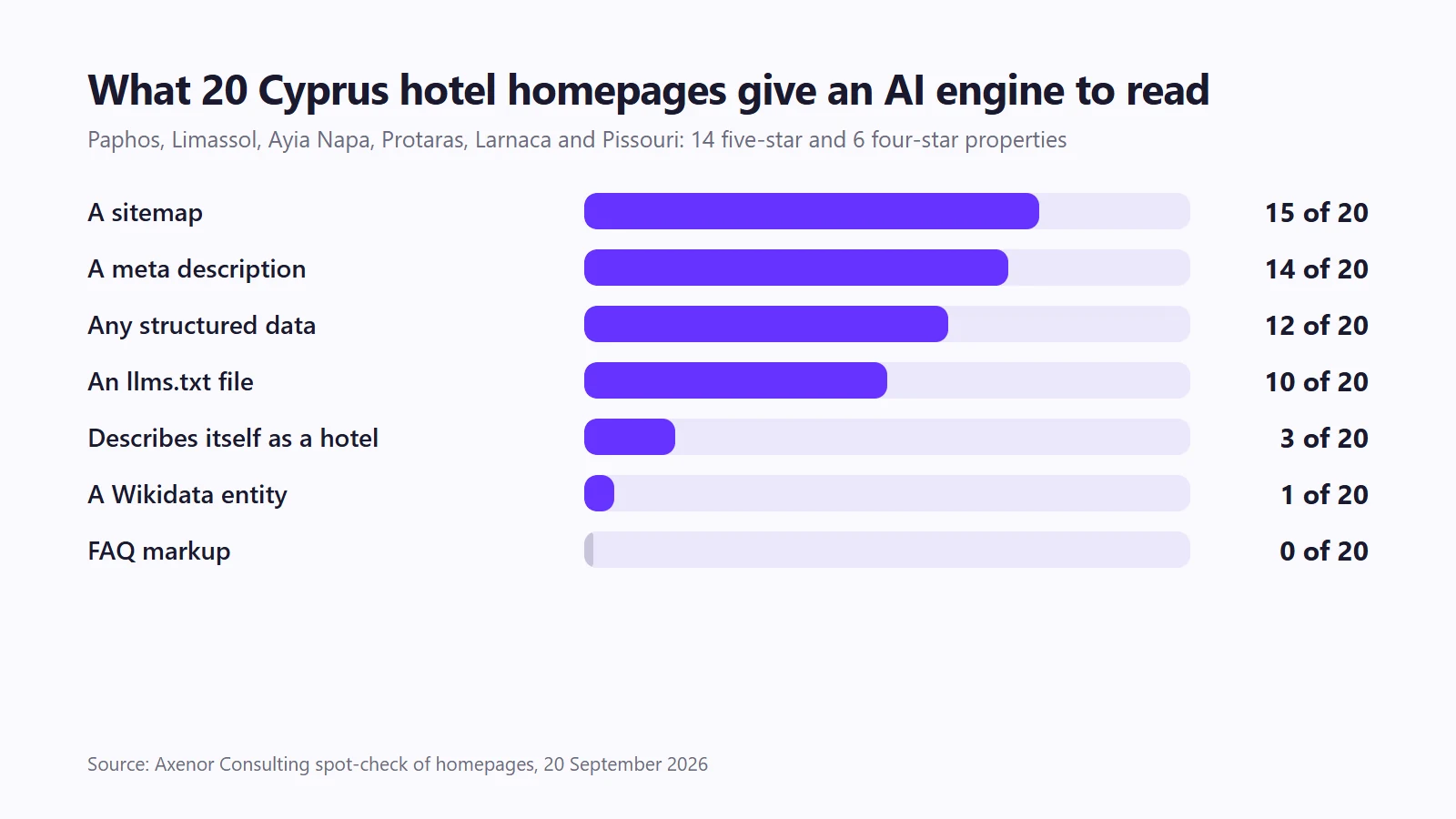
In September 2026 Axenor Consulting checked the homepages of 20 hotels in Paphos, Limassol, Ayia Napa, Protaras, Larnaca and Pissouri for what an AI engine can read. Ten serve an llms.txt file, which Google Search ignores. Three describe themselves as a hotel in structured data, and eight carry no structured data at all. None carries FAQ markup. One shuts out every crawler except Google's, and one is an empty page until JavaScript runs.
Cyprus hotels have taken up the newest file in AI search faster than the accountants and law firms we checked the same week, and skipped one of the oldest. Half the sample publishes an llms.txt. Three in 20 tell an engine, in the vocabulary engines read, that the business is a hotel, where it is and what it offers. Below are the counts, what each means for a hotel that wants to be named in AI answers, and the order in which to fix them.
How did we check the hotel websites?
We fetched each hotel's own homepage once, on 20 September 2026, with a plain HTTP request and no JavaScript, which is how AI crawlers read a page. Booking platforms were not part of the check. For each site we recorded the structured data and its schema.org types, the title and meta description, any FAQ markup, the robots.txt rules for eight crawlers, whether the site serves an llms.txt file and a sitemap, its language alternates, the amount of text in the raw HTML, and whether the hotel has a Wikidata entity.
Thirteen of the 20 are five-star properties and seven are four-star. The list was fixed before any result was seen. One hotel whose own domain would not load was replaced with the next on the list. We publish counts, not names. The limits: 20 hotels, one date, homepages only.
Do Cyprus hotel websites tell an engine they are a hotel?
Three of 20 do. Twelve carry structured data of one kind or another. In eight of those 12 it stops at Organization: a company name and a logo, with nothing about rooms, location, star rating or facilities. One declares only that the page is a website. Eight carry no structured data of any kind.
The three that use the Hotel type from schema.org go a long way with it: address, coordinates, star rating, room types and offers. Two of the three share a template, which suggests one team made the decision once and applied it across its properties.
Structured data does not earn citations by itself. When Ahrefs tracked 1,885 pages that added it, in a controlled test published in May 2026, AI citations barely moved. For a hotel it does a different job. Google reads business markup for the facts a traveller filters on, and an engine assembling an answer about family hotels in Paphos needs those facts from somewhere. If the hotel does not state them, a booking platform will, and the platform gets the citation.
Why do half of Cyprus hotel websites have an llms.txt file?
Because the files appear to come with the website, not from a decision. Ten of the 20 hotels serve an llms.txt, against 4 of the 20 professional-services firms we checked the same week. Two of the hotel files open with the same heading, word for word, and two more share a format, so the files look like part of a vendor package.
Having one does no harm. There is no evidence it helps. Google's guide to its generative AI features, updated in July 2026, states that Google Search ignores the file, and no AI engine has confirmed using one to choose citations. Our llms.txt guide sets out the evidence. The finding here is the order of work: seven of the ten hotels with an llms.txt file do not describe themselves as a hotel in structured data, and three of the ten have no structured data at all.
Can AI crawlers get into Cyprus hotel websites?
At 18 of the 20, yes. The two exceptions are the costliest faults in the sample.
One hotel allows Google's crawler and three social-media bots, and disallows everything else. That shuts out OAI-SearchBot, PerplexityBot, ClaudeBot and Bingbot. OpenAI's crawler documentation is direct about the cost: a site that opts out of OAI-SearchBot will not be shown in ChatGPT search answers. ChatGPT search also sends queries to outside search providers, Microsoft among them, and this hotel turns Bing away too. The hotel can still be named, from a booking platform's page about it. The rule looks like an old security setting nobody has revisited.
One five-star hotel serves a homepage with one word of readable text and an empty title. Everything else arrives through JavaScript. Google renders JavaScript, so the site ranks. The main AI crawlers do not: Vercel and MERJ analysed crawler traffic in December 2024 and found that none of the major AI crawlers renders it. To a crawler that does not run scripts, that homepage is blank.
We put five hotel questions to ChatGPT and Perplexity the same week. ChatGPT cited no hotel's own website in any of its five answers, these two included. Perplexity cited both. Its documentation says that the fetcher it uses when a person asks a question does not follow robots.txt, and it evidently reads more of a site than the homepage we tested. One engine working around a fault is not a reason to leave the fault in place. How engines pick the pages they cite is covered in how AI engines choose what to cite.
Are five-star hotel websites any better?
No. They have the same gaps, at a higher room rate. Among the 13 five-star hotels:
- 6 carry no structured data at all
- 2 use the Hotel type
- 7 serve an llms.txt file
- none carries FAQ markup
Across all 20, seven homepages mention or link to an FAQ, which is better than the firms managed. None marks the questions up. Six have no meta description. Eight declare language alternates for their overseas markets, and one of those includes Greek. One hotel of the 20 has a Wikidata entity.
In June we ran this check on four Paphos hotels and found one that described itself as a hotel. At five times the size the picture has not improved: three in 20.
What do the readable hotel websites have in common?
A web team that did the old work before the new. All three hotels with Hotel markup also have a meta description and an llms.txt file, and none of them blocks a crawler. They are not doing anything exotic. They treat the site as something machines read as well as people.
How do you make a hotel website readable to AI engines?
Five fixes, in this order.
- Add Hotel markup to the homepage. Name, address, coordinates, star rating, check-in and check-out times, amenities, price range, and links to your profiles on the booking platforms and Google. One hour for a developer.
- Read your robots.txt. If it disallows everything except Google, fix it today. Leave OAI-SearchBot, PerplexityBot and Bingbot open.
- Put the essentials in the HTML. If the site is built in JavaScript, make sure the hotel's name, location, room types and a paragraph of description are in the page before any script runs.
- Write the ten questions guests ask and answer them on the site. Airport distance, parking, whether the pool is heated in winter, family rooms, what all-inclusive covers. These are the questions travellers now put to assistants.
- Verify the site in Bing Webmaster Tools and submit the sitemap. Ten minutes, and it opens the Microsoft route into ChatGPT search.
To see where your own hotel stands on the first three, run the homepage through our AI visibility checker, which makes the same no-JavaScript fetch we used here. The full playbook is in hotel SEO in Cyprus and why AI travel search skips hotels, and the same check on accountants and law firms is in our professional-services spot-check. Items one to three are part of every website we build. The rest belongs to SEO and AI search and to the profile work in local SEO in Cyprus.
Key takeaways
- 10 of 20 Cyprus hotel websites serve an llms.txt file. 3 of 20 describe themselves as a hotel in structured data.
- 8 of 20 carry no structured data at all, including 6 of the 13 five-star properties.
- One hotel blocks every crawler except Google's, which keeps its own site out of ChatGPT search. One homepage is blank to any crawler that does not run JavaScript.
- None carries FAQ markup. The questions guests ask assistants go unanswered on the hotels' own sites.
Frequently asked questions
Does a hotel website need an llms.txt file? No. Google's guide to its generative AI features says Google Search ignores the file, and no AI engine has confirmed using it to select citations. It takes little effort and does no harm. It should come after Hotel structured data, a working robots.txt and readable HTML, not before them.
What structured data should a hotel website have? The Hotel type from schema.org on the homepage, with name, address, coordinates, star rating, check-in and check-out times, amenities and price range, plus links to the hotel's official profiles. Room pages can carry HotelRoom and Offer. Three of the 20 Cyprus hotels we checked do this.
Why is my hotel website invisible to ChatGPT? Two causes appeared in our sample. A robots.txt that allows only Google shuts out OAI-SearchBot and Bingbot, and ChatGPT search draws on both. A homepage built entirely in JavaScript shows AI crawlers an empty page, because they do not run scripts. Each affected one hotel in 20.
Does Google still rank a hotel website that AI crawlers cannot read? Yes. Google renders JavaScript and its crawler is rarely blocked, so the site can rank normally. That is what hides the problem: the SEO report looks healthy while the hotel is missing from ChatGPT and Perplexity answers.
How do I check my own hotel's website for AI readability? View the page source and search for "application/ld+json", then look for "Hotel" inside it. Open yourdomain.com/robots.txt and read the rules under "User-agent: *". Turn off JavaScript in your browser and reload the homepage: what you see is what an AI crawler sees. Our AI visibility checker runs the same checks in one pass.