 AXENOR
Axenor Consulting checked 60 Cyprus business homepages, 20 professional-services firms, 20 hotels and 20 real estate businesses, for what an AI engine can read. 27 give no machine-readable record of the business. 15 have no meta description. One carries FAQ markup. Two have a Wikidata entity. One blocks the crawlers that feed AI search, and two show a crawler nothing until JavaScript runs.
This page collects every figure from our three checks in one place, with the sample, the date and the method next to each, so that anyone can quote a number and anyone can rerun the check. The firm and hotel checks ran on 20 September 2026 and each has its own article. The real estate check ran on 17 October 2026 and is published here for the first time.
What are the key statistics?
Each line below stands on its own. The sample is 60 Cyprus homepages unless a line says otherwise.
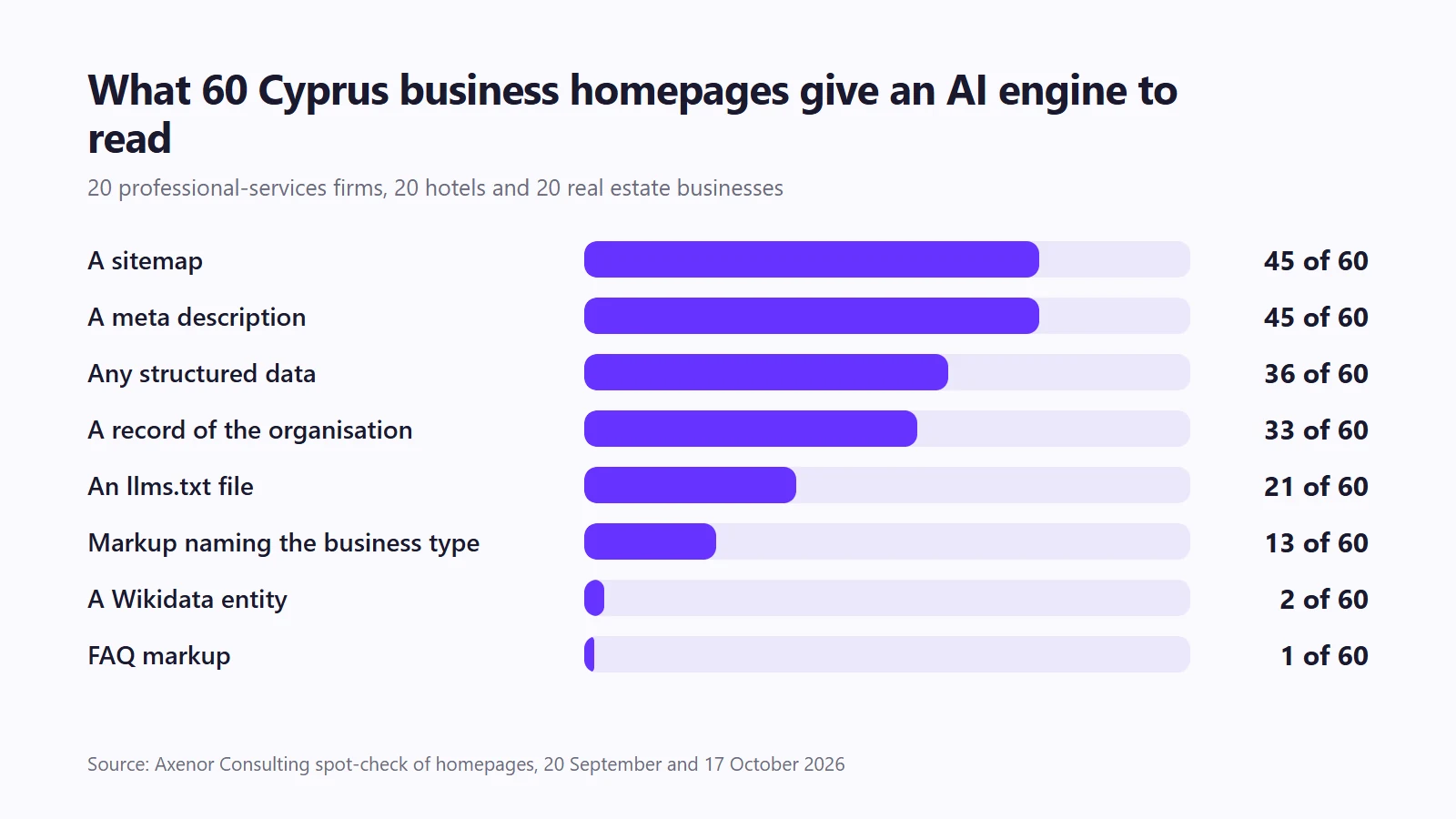
- 33 of 60 homepages give an AI engine a machine-readable record of the organisation (name, logo, address or contact details in structured data). 27 of 60 give none.
- 13 of 60 say what kind of business they are in structured data, such as Hotel, LegalService or RealEstateAgent.
- 11 of 60 have neither structured data nor a meta description: an engine gets the page text and nothing that summarises it.
- 1 of 60 carries FAQ markup. 13 of 60 mention or link to an FAQ at all.
- 21 of 60 serve an llms.txt file. Five of those 21 carry no structured data.
- 45 of 60 have a sitemap and 45 of 60 a meta description.
- 2 of 60 have a Wikidata entity.
- 1 of 60 blocks the crawlers that feed AI search answers. 4 of 60 block at least one AI crawler, in three of the four only the crawlers that gather training data.
- 2 of 60 serve a homepage that is blank, with no readable text, until JavaScript runs.
- 4 of 60 declare a Greek-language version to search engines.
How do the three sectors compare?
| Firms (20) | Hotels (20) | Real estate (20) | All 60 | |
|---|---|---|---|---|
| Any structured data | 11 | 12 | 13 | 36 |
| A record of the organisation | 9 | 11 | 13 | 33 |
| Markup naming the kind of business | 3 | 3 | 7 | 13 |
| A meta description | 12 | 14 | 19 | 45 |
| A sitemap | 15 | 15 | 15 | 45 |
| An llms.txt file | 4 | 10 | 7 | 21 |
| Mentions or links to an FAQ | 3 | 7 | 3 | 13 |
| FAQ markup | 0 | 0 | 1 | 1 |
| Blocks an AI search crawler | 0 | 1 | 0 | 1 |
| Fewer than 300 words of readable text | 2 | 1 | 2 | 5 |
| A Wikidata entity | 1 | 1 | 0 | 2 |
Real estate is the most readable of the three. Every agency or developer with structured data also gives an organisation record, and 19 of 20 write a meta description. Six agencies use the RealEstateAgent type from schema.org, so an engine can tell an estate agent from a law firm without guessing. The professional-services firms are the least readable: 11 of 20 give an engine no record of the business, and none carries FAQ markup. Our study of the firms and study of the hotels break those groups down further.
What did the real estate check find?
Thirteen of the 20 real estate homepages carry structured data, and all 13 describe the business behind the page. Ten are agencies and ten are developers, and the split runs one way: six of the ten agencies say they are an estate agent in markup, and none of the developers says what it is beyond "Organization" or "LocalBusiness". One developer is the only site among all 60 with FAQ markup on its homepage.
Seven of the 20 serve an llms.txt file and none has a Wikidata entity, the only group of the three with none. Two agencies shut out CCBot, the Common Crawl crawler that gathers training data, and leave every search crawler alone. One agency homepage, part of an international franchise, serves no title and no text to a crawler that does not run scripts. Google renders JavaScript, so the page can rank. Vercel and MERJ's analysis of crawler traffic found that the major AI crawlers do not, so to them that homepage is empty.
How was the check done?
We fetched each homepage once with a plain HTTP request and no JavaScript, which is how AI crawlers read a page. For each site we recorded the structured data (JSON-LD) and its schema.org types, the title and meta description, FAQ markup and any FAQ mention or link, the robots.txt rules for eight crawlers (GPTBot, OAI-SearchBot, ChatGPT-User, PerplexityBot, ClaudeBot, Google-Extended, CCBot and Bingbot), whether the site serves an llms.txt file and a sitemap, its language alternates, and the amount of readable text in the raw HTML. We then searched Wikidata for each business by name and judged each hit by hand.
Each sample was fixed before any result was seen.
- Firms (20 September 2026): 7 corporate-services firms from the Cyprus Fiduciary Association's member list, 7 accounting and audit firms and 6 law firms.
- Hotels (20 September 2026): 13 five-star and 7 four-star hotels in Paphos, Limassol, Ayia Napa, Protaras, Larnaca and Pissouri, each on its own domain.
- Real estate (17 October 2026): the first 10 agencies with their own website in Google Cyprus results for "real estate agency cyprus", and the first 10 developers for "property developers cyprus", read signed out, in result order. Directories, portals, lists and social profiles were skipped, and so were businesses that are Axenor Consulting clients. One developer's site refused a plain request, so it was replaced with the next result.
The script is the same for all three groups, and recounting the September files with it reproduces every published figure. We publish counts, not names. The limits are plain: 60 sites, three sectors, two dates and homepages only. A business may carry markup deeper in its site that this check did not see, and a site can change the day after it is read.
What do the numbers mean for a Cyprus business?
The door is open and the room is bare. Fifty-nine of the 60 sites let the AI search crawlers in, but 27 do not tell them whose site it is. Google uses Organization markup to tell one business from another with a similar name, and its guide to generative AI features says SEO best practices "continue to be relevant" for them. An engine that cannot confirm a business from its own site leans on a directory or a booking platform that can.
The fixes cost hours, not budgets: an organisation record with the business type, a meta description, a short FAQ in plain text with markup, and a homepage that shows its words without JavaScript. Our guide to entity SEO covers the Wikidata step. To see where your own site stands, run the AI readability check: it tests the same things on any homepage in about 30 seconds.
Frequently asked questions
Can I quote these statistics? Yes. Please cite Axenor Consulting with the sample and the date, for example "27 of 60 Cyprus business homepages give no structured record of the business (Axenor Consulting, September and October 2026)", and link to this page so readers can see the method.
Why are the businesses not named? The check describes a market, not individual firms. A count shows how common a gap is without singling out a business that may already be fixing it, and every business in the sample can rerun the check on its own site.
Does structured data get a business cited by AI engines? Not by itself. It removes doubt about who the business is and what it does, which matters when an engine chooses between two similar names. Citations still depend on the page answering the question that was asked, which is why FAQ content matters more than markup alone.
Why would a site have an llms.txt file but no structured data? In the hotel group the files looked like part of a vendor package rather than a decision: two open with the same heading, word for word. Google says Google Search does not use llms.txt, while Google and Bing both read structured data. Five of the 21 sites with the file carry no structured data at all, which is the order of work reversed.
Will you repeat the check? Yes. We plan to rerun all three groups with the same script and the same samples in the first quarter of 2027 and publish the change next to these figures.